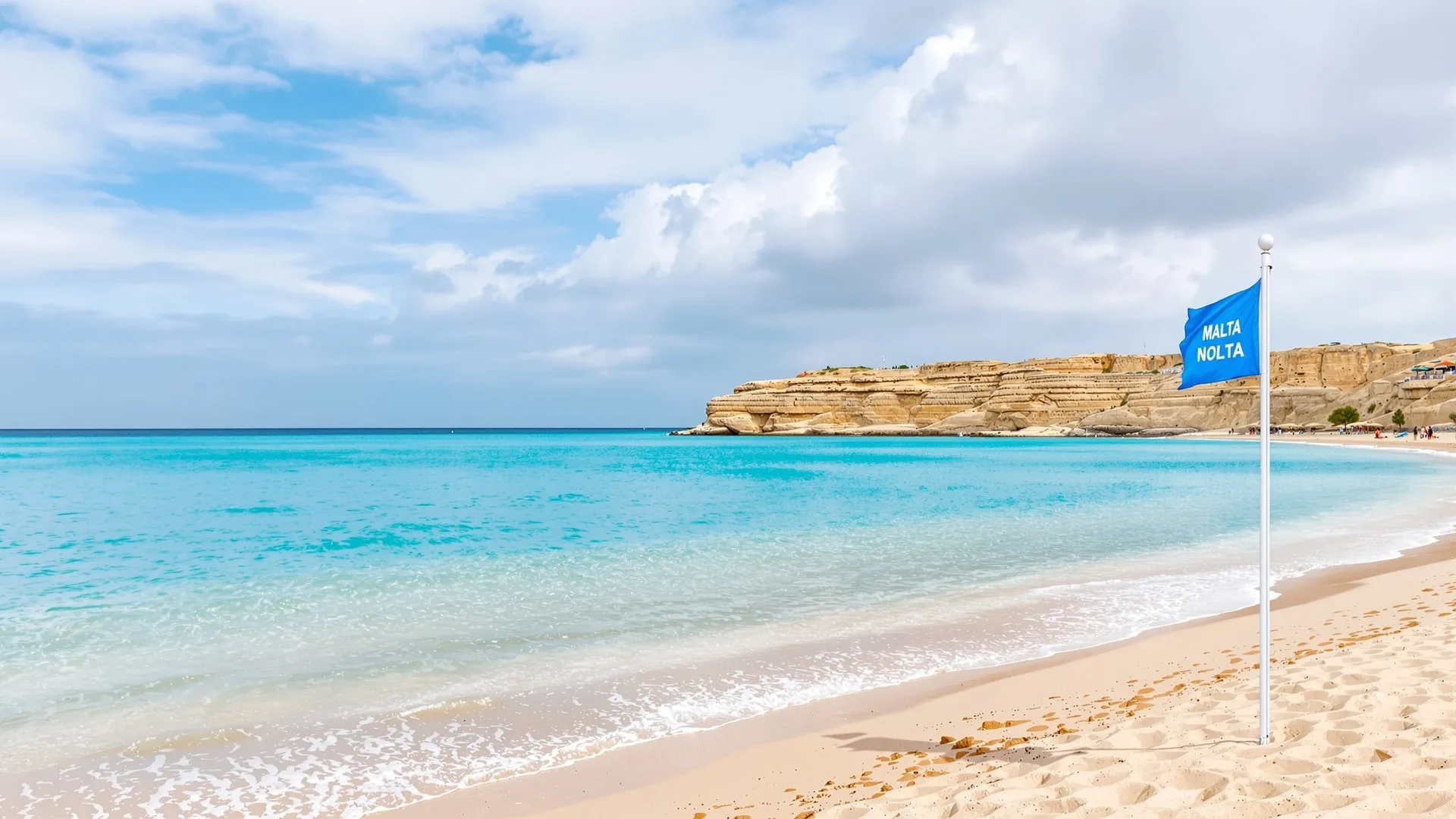
Malta's Blue Flag beaches in 2023: the real list
Malta's Blue Flag beach list for 2023 decoded: which ones are worth visiting, which are crowded, and where the sandy water actually is
At a glance: Malta’s Blue Flag beaches
| Best all-round sandy beach | Mellieha Bay (arrive before 8am in summer) |
| Most photogenic | Golden Bay |
| Quietest certified beach | Ghajn Tuffieha (steep steps) |
| Best non-certified spot | St Peter’s Pool |
| Best month for clear, warm water | September |
What Blue Flag means in a country that is mostly rock
If you have spent more than 48 hours in Malta, you already know the quiet secret of the island’s coastline: it is predominantly limestone rock. Rocky shores, concrete lidos, and narrow channels cut into the limestone make up the bulk of Malta’s swimming infrastructure. Actual sand — the soft, shoeless kind you can walk on barefoot from a towel to the waterline — is a minority experience.
That makes the Blue Flag certification here a bit different from what you might expect in Spain or Greece. The Blue Flag programme assesses water quality through regular testing, environmental management, safety services, and facilities. It does not assess how sandy or photogenic the beach is. So you can have a Blue Flag-certified swimming area on a concrete platform with a rope keeping boats back and a ladder into the sea. Malta has several of those.
This is important to understand before you plan your beach days around the official list. “Blue Flag beach” in a Malta context does not automatically mean sand, clear entry from a shore, or the kind of beach holiday environment many visitors are expecting.
The actual Blue Flag list for Malta 2023
In 2023, Malta had 14 Blue Flag certifications covering beaches and marinas. The beaches on the list included:
Mellieha Bay (Ghadira Bay)
The largest sandy beach in Malta, and the one that most closely matches what most visitors are looking for when they say “beach.” Mellieha Bay has a broad stretch of proper sand extending into shallow, gradually deepening water. It has a lifeguard station, water sports rentals (pedalos, kayaks, paddleboards), beach bars, and basic services throughout the season.
Gets extremely busy in summer — on August weekends, the beach is genuinely packed from 9am. Arrive before 8am for a comfortable spot, or come after 4pm when the crowd starts to thin. Parking fills up early; the bus from Mellieha village or Bugibba is often quicker and avoids the car park queue.
Worth it: absolutely, but manage the timing.
Golden Bay
A sandy beach in the northwest, smaller than Mellieha but more scenic, framed by dramatic red clay and limestone cliffs on both sides. Golden Bay has a beach bar, sun lounger rentals, and basic facilities. It has been Blue Flag certified for many years running. Gets crowded in summer but is slightly less overwhelming than Mellieha on account of its smaller size — which paradoxically means it fills up faster.
The visual setting is one of the most photogenic on the main island. The contrast of the red clay cliffs, the golden-orange sand, and the clear blue water is genuinely striking.
Worth it: yes, particularly in shoulder season.
Ghajn Tuffieha (Riviera Beach)
Just south of Golden Bay, accessible only via a steep staircase of around 200 steps. The effort required to reach it keeps it measurably less crowded than Golden Bay despite being directly adjacent. Sandy, lovely, with no services apart from a seasonal kiosk at the top of the steps. The beach itself is largely natural.
The steps up — after a swim and some beach time in heat — are a genuine workout. If mobility is a consideration, this beach is not suitable.
Worth it: yes, if your knees are happy and you want something quieter.
Pretty Bay (Birzebbuga)
A sandy beach in the south of Malta with Blue Flag certification, but situated immediately adjacent to the Malta Freeport container terminal. The visual backdrop is industrial — cranes, shipping containers, large vessels. Water quality consistently passes the certification tests, and the sand and facilities are decent, but the setting is psychologically difficult to appreciate fully.
Worth it: rarely, unless you are staying in the south and need a quick swim.
St George’s Bay (St Julian’s)
A compact, mixed sandy-and-pebble beach right in the heart of St Julian’s, surrounded by hotels and restaurants. Convenient for people staying in the area. Very much an urban beach — you swim with the city immediately around you. Popular with local residents in the evenings.
Worth it: for the convenience and the social atmosphere, not for seclusion.
Marsaskala (St Thomas Bay)
A sandy beach in the southeast with Blue Flag status. Small, less visited than the northwest beaches. Quieter on summer weekends than Mellieha or Golden Bay. The town of Marsaskala has some decent seafood restaurants within walking distance, making this a reasonable choice for a combined beach-and-lunch outing.
Worth it: if you are in the south and want quiet.
Lido-style certified areas
Malta’s Blue Flag count includes several managed lido areas — essentially concrete platforms with professional water entry management, facilities, and tested water. These are popular with Maltese residents, less intuitive for visitors expecting a sandy beach. The entry fee for managed lidos is typically 5-8 euros and includes a sun lounger on the platform.
The beaches that should be on your radar regardless of certification
Blue Flag certification is a useful quality signal but is not a complete guide to Malta’s best swimming. Some of the most memorable spots have no certification — partly because they have no facilities to manage, which is also why they are beautiful.
St Peter’s Pool
A natural swimming hole near Marsaxlokk, carved from limestone by centuries of wave action. No sand, no services, no certification. What it has is extraordinary water clarity — you can see ten to twelve metres down to the rock formations below. People jump from the overhanging limestone slabs. On a calm summer morning, the water colour is an almost hallucinogenic turquoise.
Get there early; by late morning in summer it fills up and parking along the approach road becomes limited. Several boat tours specifically visit St Peter’s Pool as a swimming stop, which is a good option if you want a guide and don’t want to drive the final approach road.
From Marsaxlokk: St Peter's Pool Boat Tour↗Crystal Lagoon (Comino)
Less crowded than the Blue Lagoon on the Comino side facing Gozo, with equally stunning water. No sand, no services, accessible only by boat. See our honest take on Comino for the full context on how the two lagoons compare and which one to prioritise at different times of day.
Armier Bay and Little Armier
Two small bays in the far north of Malta, sandy, popular with Maltese families for summer weekends. Less known to international tourists. No Blue Flag certification but consistently good water quality. The road to Armier Bay passes through a genuinely local summer enclave — Maltese families with seasonal wooden cabins along the shore.
Ramla Bay (Gozo)
The best beach in the Gozo-Malta archipelago by most measures. A wide, gently curved bay with distinctive orange-red sand — the colour comes from the iron-rich clay in the surrounding cliffs. Protected by national park status, so no commercial development on the beachfront itself. Can get busy in peak summer but remains dramatically less crowded than Mellieha Bay on the worst August weekends. Accessible by bus from Victoria or by organised tour.
Water quality: the honest picture
Malta’s Blue Flag certifications reflect genuinely good water quality in most years. The island invests in coastal water monitoring and the standards are EU-compliant. The Mediterranean around Malta tends to be clear, warm, and relatively calm.
The caveats:
After heavy rain — which comes more frequently in spring and autumn — some bays near storm drainage outlets can temporarily see quality drops. In 2023, brief non-compliance periods were reported at a small number of sites. These are typically short-lived, resolved within 24-48 hours. The infrastructure for separating storm water from sewage outflows has improved over the past decade but is not complete everywhere.
In July and August, the combination of boat traffic (particularly around Comino’s Blue Lagoon) and the sheer number of swimmers produces visibly turbid water at the most popular spots during peak hours. This is not a Blue Flag issue — the certification tests happen periodically, not continuously during peak crowd hours — but it is a real quality-of-experience issue. The difference between visiting the Blue Lagoon at 8am and at 1pm on a August day is extraordinary, and both visits are within the same Blue Flag period.
The clearest, warmest swimming is generally in September, when sea temperatures peak at 25-26°C, summer crowds have started to thin, and the sea has settled back into clarity after the summer intensity.
Practical tips for planning beach days in Malta
Parking: Mellieha Bay and Golden Bay both have car parks that fill by 9:30am in high summer. Arrive early or take the Tallinja bus — both are served by routes from the main resort areas, and in summer this is often significantly faster and cheaper than driving.
Sun loungers: Available at Mellieha Bay, Golden Bay, and managed lidos. Bring your own towel and claim a spot on public sand for free. Lounger costs have risen; expect 5-8 euros per lounger per day in 2023 at the main beaches.
Facilities: Only Mellieha Bay and Golden Bay have lifeguards throughout the full season. At smaller beaches and all natural swimming spots, swim at your own risk. Water shoes are strongly recommended for any rocky entry point.
Water temperature by month: The sea around Malta ranges from about 15°C in February (cold) to 26°C in August-September (warm and comfortable). April and May hover around 17-19°C — possible for confident swimmers but not comfortable for long immersion. From late May, most people find it pleasant. September is the sweet spot: peak warmth, thinner crowds.
Transport for beach days: The Tallinja bus network covers Mellieha Bay directly. For Golden Bay and Ghajn Tuffieha, buses go to the nearby area with a short walk. For more remote spots like St Peter’s Pool and Armier Bay, a car or taxi is necessary.
For a full Malta beach planning guide including the best spots for diving, snorkelling, and family swimming, see our destination overview. And for Gozo beaches specifically, Ramla Bay deserves its own dedicated morning rather than being squeezed into a day trip that covers the temples and Dwejra as well.
Sea temperature and crowd levels by month
| Month | Sea temp | Crowd level |
|---|---|---|
| April-May | 17-19°C | Low |
| June | 22-23°C | Building |
| July-August | 25-26°C | Peak, arrive before 8am |
| September | 25-26°C | Thinning, best overall balance |
| October | 22-23°C | Low, still swimmable |
| Nov-March | 15-17°C | Minimal, no swimming for most |
If diving or snorkelling beyond the certified beaches is on the agenda, our best snorkelling spots in Malta guide covers the sites that pair well with a Blue Flag beach day, and St Peter’s Pool by boat is a good add-on for anyone basing themselves near Marsaxlokk.
FAQ
Which Malta beach has the most reliably clear water? St Peter’s Pool near Marsaxlokk is often cited for clarity, though it has no facilities or certification; among Blue Flag beaches, Golden Bay and Ramla Bay in Gozo tend to have the clearest sand-bottomed water.
Is Malta’s Blue Flag list the same every year? The core beaches (Mellieha Bay, Golden Bay, Ghajn Tuffieha, St George’s Bay) tend to hold certification year after year; the full list can shift slightly depending on annual water quality testing.
Related guides

Village festas in Malta: fireworks, brass bands and patron saints
Every summer weekend a different Maltese village celebrates its patron saint with deafening fireworks, brass bands and processions. Completely free

Malta in summer: heat, crowds and what is still worth doing
Malta in summer is hot (28–32°C), crowded and expensive. Sea is 25°C, festas happen every weekend and Valletta sunsets are extraordinary. Survival guide

Carnival in Malta and Gozo: Valletta, Nadur and what to expect in 2026
Malta Carnival 2026 runs 10–13 February. Valletta's is colourful and family-friendly. Nadur in Gozo is dark, strange and unique in Europe. Both are free

Malta in autumn: October and November, the quiet return
Autumn in Malta is excellent: September is the best month of the year (warm sea, easing crowds). October is still good. November is quiet and cheap. Full guide