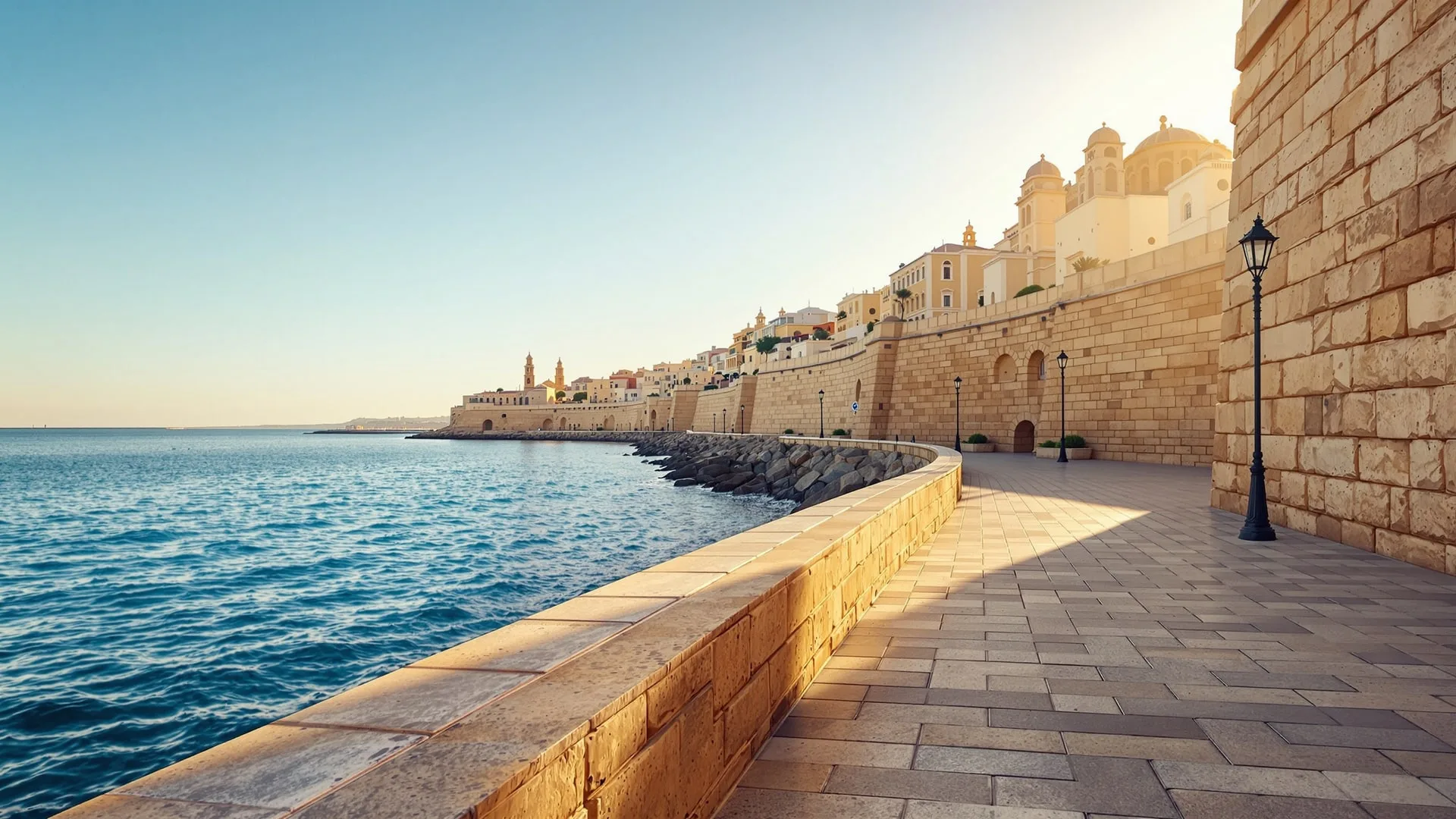
Malta in December: light crowds, mild swims, real prices
Malta in December is quieter and cheaper than most expect. Honest weather picture, what stays open, and whether the Christmas markets are worth visiting
At a glance — Malta in December
| Daytime temps | 15-17°C, overnight 11-13°C |
| Sea temp | Around 16-17°C — cold-water swimming only |
| Flights (UK, outside Christmas week) | Around €120-160 return, vs €280-380 in August |
| Hotels (Sliema, mid-range) | Around €70-95/night, vs €150-170 in August |
| Best for | Cultural sightseeing, food, value — not beach holidays |
| Avoid if | Swimming and guaranteed sunshine are your priority — try May or later instead |
The month that the tourist machine pauses
There is a particular quality to Malta in December that you do not encounter in the other eleven months: it feels, genuinely and unambiguously, like it belongs to the Maltese people rather than to the visitors. The cruise ships thin out dramatically — some weeks none at all, particularly in the first half of the month. The streets of Valletta are walkable without navigating around tour groups. The restaurants in the most tourist-concentrated areas either close for their annual refurbishment or pivot back to serving their local clientele.
The Blue Lagoon on Comino is accessible only by private tour boat, since the regular summer ferries from Mellieha stopped in October. This is a feature, not a bug — Comino in December, by private arrangement, has a quality of solitude that is genuinely moving.
I have been to Malta in December twice, once as a solo trip for four days and once for a longer week. I would go again without hesitation. But I want to give you an accurate picture of what December in Malta involves, so you can decide whether it is the trip for you.
The weather: managing expectations honestly
December average temperatures in Malta: daytime 15-17 degrees, overnight 11-13 degrees. This is genuinely mild by northern European standards — a pleasant October day in the UK, a cool autumn day in Paris, warmer than anything in northern Europe this time of year. You need a jacket in the evenings, particularly if there is wind, and something waterproof is sensible to have available.
What December weather in Malta is not: warm enough for comfortable beach swimming in the conventional sense. The sea in December is around 16-17 degrees. That is cold by Mediterranean standards, though determined swimmers do go in, particularly the Maltese themselves who are considerably more inured to the cold water than most visitors. Some of the open-water swimmers who do regular December sessions at the rocky lidos in Sliema treat this as normal. For most visitors, it is a brave-person swim rather than a comfortable one.
If swimming is central to why you want to be in Malta — the warm-sea, sun-on-skin-in-the-water experience — December is not your month. Wait until late May when the sea starts warming toward 20 degrees.
Rain: Malta in December gets more rainfall than the summer months, typically concentrated in the second half of the month and in intense rather than persistent events. Malta rain in winter comes as proper rainstorms — dramatic, sometimes heavy, often accompanied by thunder — rather than the grey drizzle of northern European winters. A December trip of a week will very likely include one or two rainy afternoons or mornings. The sun will typically return within a few hours. Pack a proper waterproof jacket; an umbrella is inadequate against Maltese winter rain and wind.
Wind: the Tramontana, the north wind, can be strong in December, particularly on exposed coastal positions. Some diving and boat activities in specific locations are restricted or cancelled in strong northerlies. The Dwejra area on Gozo’s western coast, one of the best diving and walking sites, is particularly affected by north wind — conditions that are benign in June can be rough or impossible in December. This is not a reason not to go; it is a reason to have alternative plans for days when the wind is up.
What is actually open in December
The main cultural sites remain open year-round, though some with reduced hours. St John’s Co-Cathedral, Fort St Angelo in Birgu, Hagar Qim temples, Mdina, the Three Cities walking route — all open and fully functional. Heritage Malta sites often have slightly reduced opening hours in winter and some have slightly lower entrance prices outside peak season; check current hours before visiting.
The restaurant situation in December is genuinely interesting for the visitor. Tourist-facing restaurants in Valletta’s Republic Street and the main Sliema waterfront thin out, and some close entirely in January for renovation, starting to wind down in late December. What remains is the more serious restaurant stock — establishments with year-round local clientele that do not depend on summer tourist volumes. This means that the actually good restaurants are not overbooked and the service is unhurried. Reservations in December are generally not necessary at places that require two-week advance notice in August.
The Tallinja bus network operates year-round on a reduced timetable — less frequent than summer but fully functional for the main routes between Valletta, Sliema, St Julian’s, Mellieha, and Bugibba. The Valletta-Sliema ferry runs year-round, typically until around midnight.
What is reduced or closed: Comino regular ferry services (private charters and specialist boat tours continue). Most beach bars and kiosk operations at coastal spots. Some smaller seasonal tour operations. Popeye Village has reduced hours and reduced activities.
The Christmas programme: honest assessment
Valletta runs Christmas markets in December, typically through the first three weeks of the month, with the main installation usually centred around St George’s Square or Freedom Square. The markets have grown in recent years — more stalls, better organisation, more international participation — but they remain modest by German or Austrian standards. Malta’s Christmas market tradition is newer and more modest than central European ones, and visiting specifically for the market experience requires calibrated expectations.
What the markets offer: local food producers selling Maltese products (honey, nougat, traditional biscuits, local wine and limoncello), craft stalls, a modest amount of international Christmas food and mulled wine, and the experience of being in a baroque limestone city that is genuinely attractively decorated for the season. The visual effect of Christmas lights and decorations against Valletta’s stone architecture is lovely. The market itself, in scale, is perhaps one-third the size of a mid-sized European Christmas market.
If you are expecting a Strasbourg or Vienna Christmas market, recalibrate significantly. If you enjoy a pleasant, nicely decorated city with local food and craft stalls and a festive atmosphere without being overwhelmed, Malta delivers that.
The 8th of December — the feast of the Immaculate Conception — is a national public holiday and has church processions in several towns that are worth looking out for if you are there on that date. The Maltese approach religious public holidays with genuine seriousness; these are not tourist performances.
Prices in December: the real numbers
Flights to Malta in December (outside Christmas week) are among the cheapest of any time of year. For UK departures, December flights commonly run at 120-160 euros return per person — compared to 280-380 euros for August peak. That is a saving of roughly 120-220 euros return per person, or 240-440 euros for a couple.
Hotels are correspondingly reduced. A mid-range 4-star hotel in Sliema that runs 150-170 euros per night in August can be found for 70-95 euros in December. Budget properties are proportionally cheaper; luxury properties show smaller percentage discounts but still meaningful savings in absolute terms.
The exception is Christmas week (24-27 December) and New Year’s week, when prices spike — not to summer levels, but to spring shoulder-season levels. If you are planning specifically for Christmas in Malta, arriving on 22 or 23 December and leaving on the 27th or 28th captures both the Christmas atmosphere and the best combination of price and experience.
Restaurant prices do not change dramatically between season and off-season in most Maltese establishments (unlike in some Mediterranean destinations where menus genuinely shift). The tourist-trap premium on the main tourist streets exists year-round; the value option of eating a block away from Republic Street exists year-round.
What December Malta is genuinely good for
The cultural sites are excellent in December, without qualification. Valletta without summer crowds is the city as it was designed to be: walkable, legible, contemplative. The Grand Master’s Palace, the cathedral, the harbour views from Upper Barrakka — all are significantly more enjoyable without the August-level density. The narrow streets of the capital allow you to actually look at the architecture.
Mdina in December, particularly in the early evening, is one of the best experiences Malta offers. The minimal visitor numbers, the outdoor lighting of the baroque buildings, the total quiet — it earns the “silent city” name more genuinely in winter than in any other season.
The Three Cities are excellent in December. The waterfront of Birgu has a particularly compelling quality in winter: the boats are there, the cafes are open, the harbour is still beautiful, but the visitor density that reduces the experience in summer has completely lifted. Fort St Angelo in December, with perhaps a handful of other visitors, is a very different experience from August.
For cultural travellers — people for whom art, history, architecture, and the texture of a place are the primary attraction — December Malta represents genuinely outstanding value. The same heritage, the same extraordinary water views, the same food, at 40-50% of the summer cost, with a fraction of the people.
Gozo in December: a quieter version of an already quiet island
Gozo in December takes the mainland Malta low-season effect and doubles it. The Victoria/Rabat citadel, normally busy with day-trippers off the ferry, is close to empty by mid-morning on weekdays. The Ċirkewwa-Mġarr ferry itself runs a reduced but reliable winter schedule, and the crossing in December — grey-green sea, low winter light — has its own particular beauty that the packed summer crossing does not.
Ġgantija temples are open year-round and genuinely better experienced without a coach group moving through at the same time as you. The trade-off: some smaller Gozo restaurants and guesthouses close for a few weeks around January for their own break, so book ahead by phone or email if you have a specific place in mind rather than assuming you can walk in.
Packing for a December Malta trip
The single most common mistake visitors make is packing as though Malta in December equals a Mediterranean summer with a light cardigan. It does not. Bring a proper waterproof jacket (not just an umbrella — the wind makes umbrellas nearly useless in a squall), layers for evenings that drop into the low teens, and comfortable closed shoes for wet cobblestones in Valletta and Mdina, which get genuinely slippery in rain. If you intend to swim at all, a wetsuit or at minimum a rash vest makes the 16-17°C sea tolerable for more than a token dip.
December Malta vs other Mediterranean winter destinations
The comparison most often made: Malta versus the Canary Islands for a winter sun break. This is a different trade-off than most guides acknowledge. The Canary Islands are significantly warmer and drier in December and January — Gran Canaria or Tenerife get more reliable sunshine, higher temperatures (19-22 degrees), and more consistent conditions for beach time. Malta is cooler and wetter, but has incomparably more cultural depth.
If you want guaranteed sunshine and beach weather in December, the Canary Islands are the honest choice. If you want a city break with extraordinary heritage, excellent food, and mild temperatures rather than hot ones, Malta is the right choice — and it is considerably cheaper than the Canaries have become.
For planning a December Malta trip that makes the most of the off-season advantages — cultural focus, low crowds, real prices — see our full planning guide. And for budget planning across all seasons, December represents the clearest value case of any month in the Maltese calendar.
FAQ
Is it too cold to visit Malta in December? No — daytime temperatures of 15-17°C are mild by northern European standards, though the sea at 16-17°C is too cold for comfortable swimming for most visitors.
Does the Gozo ferry run in December? Yes, the Ċirkewwa-Mġarr ferry runs a reduced winter schedule year-round; only the separate Comino Blue Lagoon ferry service stops for the season.
Related guides

Malta in winter: the case for a serious shoulder destination
Malta in winter is quiet, cheap and genuinely rewarding for culture. 13–17°C, no crowds, 40% lower hotel prices. Sea not swimmable but all sites are open

Carnival in Malta and Gozo: Valletta, Nadur and what to expect in 2026
Malta Carnival 2026 runs 10–13 February. Valletta's is colourful and family-friendly. Nadur in Gozo is dark, strange and unique in Europe. Both are free

Village festas in Malta: fireworks, brass bands and patron saints
Every summer weekend a different Maltese village celebrates its patron saint with deafening fireworks, brass bands and processions. Completely free

Malta in autumn: October and November, the quiet return
Autumn in Malta is excellent: September is the best month of the year (warm sea, easing crowds). October is still good. November is quiet and cheap. Full guide