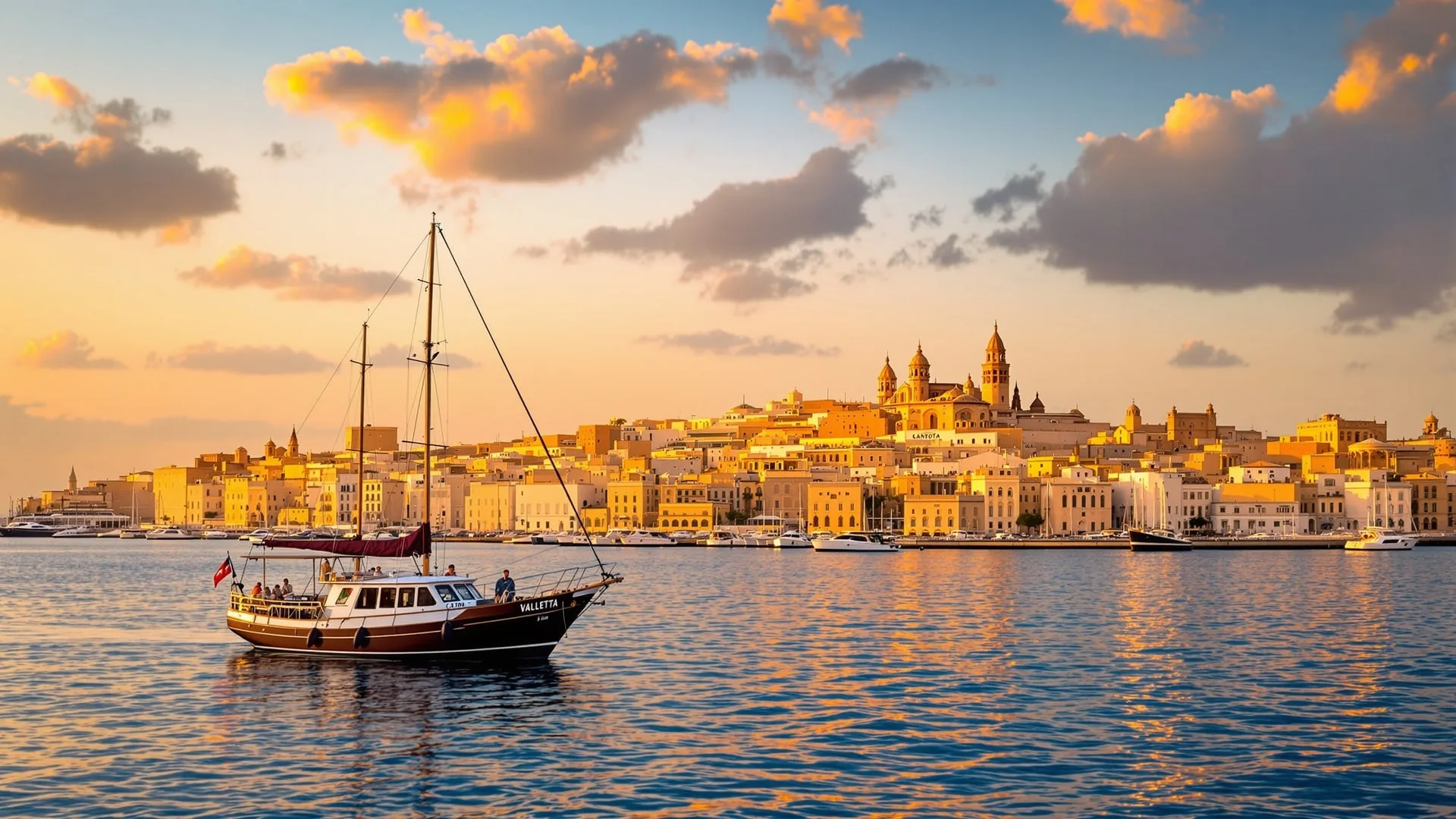
Why Malta is the most underrated of our six spirit countries
After building travel sites for six destinations, here's why Malta keeps surprising us — and what makes it genuinely different from the others we cover
Six countries, one honest comparison
At a glance: Trip length needed: a week does Malta justice, versus two weeks-plus for Canada or Oman. Flight time from Europe: 2.5-3 hours, shortest of the six. Cost tier: mid-range, cheaper than Switzerland, comparable to Morocco and Costa Rica. Best for: history, food, and compact logistics over vast landscapes.
We run travel planning sites for six destinations: Malta, Canada, Oman, Costa Rica, Morocco, and the Swiss Alpine route. We have collectively spent years researching, writing, and thinking seriously about each of them. I have personally visited all six, some many times. And I want to make an argument — honestly, based on that experience — that Malta is the most systematically underestimated of the group.
Not the most dramatic. Not the cheapest. Not the most biodiverse or the most architecturally overwhelming or the most culturally complex. But underestimated: the gap between what travellers expect when they book and what they find when they arrive is wider here than anywhere else we cover. And that gap is consistently in one direction — people expect less and get more.
The expectations problem
Malta suffers from what I think of as the “beach holiday bracket” problem. When British and northern European travellers think about Malta, they typically categorise it alongside Majorca, Corfu, Tenerife, and the Algarve: cheap flights, reliable sun, hotel resort infrastructure, not much to do after the pool. That framing puts Malta into a comparison set where it absolutely does not belong.
The mistake is understandable. Malta is close to most European source markets — three hours from London, two and a half from Paris. It has reliable summer sun and warm Mediterranean water. It has a large tourism infrastructure including resort hotels, all-inclusive options, and package holiday operators. And it is routinely sold by those package operators as a summer sun destination, in brochures that emphasise beaches and nightlife while saying almost nothing about the UNESCO World Heritage Sites, the medieval fortifications, or the extraordinary literary and military history compressed into 316 square kilometres.
The result is that many people arrive in Malta with the expectation of a slightly exotic beach holiday, discover something much more interesting, and spend the rest of the week scrambling to see more. This is not a bad problem to have as a destination, but it does mean that a disproportionate number of Malta visitors are badly under-prepared for what they are actually going to find.
What Malta actually is
Malta is a sovereign EU member state that has been continuously inhabited for 7,000 years and has more UNESCO World Heritage Sites per square kilometre than almost anywhere in Europe. It has been, at various points in history, the seat of a Phoenician colony, a Roman province, an Arab emirate, a Norman kingdom, an outpost of the Kingdom of Aragon, the base of the most famous crusading military order in history (the Knights of St John), a French possession, a British Crown Colony, and since 1964 an independent republic.
Every one of those transitions left something behind. The Hypogeum — the underground funerary complex carved from solid rock between 3600 and 2500 BCE — predates Stonehenge by a thousand years. The Ggantija temples on Gozo are the oldest free-standing structures on Earth. Valletta was purpose-built in 1566 by a crusading military order to an urban plan drawn up by Francesco Laparelli (a protégé of Michelangelo) and remains one of the most intact 16th-century planned cities in the world.
Inside St John’s Co-Cathedral, Caravaggio painted what is considered by many art historians to be his greatest work — the Beheading of St John — now hanging in the oratory, in the building it was made for. The Grand Harbour was the site of the Great Siege of 1565, the most consequential military confrontation in the history of the Mediterranean, and the most sustained aerial bombardment of the Second World War outside Stalingrad.
None of our other six destination sites have this density of layered history in this physical space.
How Malta compares to the others, honestly
Against Canada
Canada is extraordinary: vast, geographically diverse, genuinely one of the great travel destinations in the world. Banff, the Rockies, the maritime provinces, Quebec, the Great Bear Rainforest — the range is incomparable. But Canada is also enormous, expensive to travel internally (a domestic flight can cost more than a transatlantic one), and requires significant time to experience properly. A meaningful Canada trip is two weeks minimum. Malta can be fully and deeply explored in a week by any serious visitor. The intensity of experience per day of travel is completely different.
Against Oman
Oman is one of the most hospitable and visually dramatic countries on Earth. The desert landscapes, the Hajar Mountains, the wadis, the forts — genuinely extraordinary. But it is also a long-haul destination (5-6 hours from most European cities), with significant summer heat that limits when you can comfortably travel, limited public transport, and very remote areas that require expedition planning. Malta is a 2.5 to 3-hour flight from most European source markets and has EU-standard infrastructure throughout.
Against Costa Rica
Costa Rica’s appeal is biodiversity and active tourism: cloud forests, wildlife, surf, active volcanoes. It is excellent at what it does. But it occupies almost no competitive space with Malta — they are for entirely different kinds of travel. Costa Rica is for people who want to be in nature; Malta is for people who want to be in history, culture, and also in nature. The comparison that matters is how you spend your one European trip this year, or which Mediterranean island you choose. Against those comparisons, Malta is dramatic.
Against Morocco
Morocco is an extraordinary country with deep, layered culture and some of the most visually arresting urban environments in the world — Fez medina, Chefchaouen, the souks of Marrakech. It also has service and infrastructure inconsistency that requires patience and adaptability from visitors, a notable language barrier in rural areas, and a complex tourism economy that can make navigating the country exhausting. Malta is reliably easy: EU infrastructure, English universally spoken, no significant hassle culture, fully predictable services.
Against the Swiss Alpine route
Switzerland is the premium comparison in our portfolio — genuinely among the most beautiful places on Earth, intensely managed, and very expensive. A week in Switzerland costs roughly two to three times a comparable week in Malta. The scenery is spectacular. But for cultural and historical depth, Malta has a different kind of density — not better or worse than Alpine scenery, but different in kind.
What makes Malta specifically undervalued
The combination of factors that should make Malta a more seriously regarded destination:
Scale as advantage. Malta’s compactness — 27 kilometres by 14 kilometres — means you can cover an extraordinary amount in a short trip. From Sliema, Mdina is 20 minutes by taxi, Hagar Qim is 30 minutes, Gozo is 90 minutes including the ferry. There is no “we didn’t have time to get there” problem on a well-planned Malta trip. This is different from every other destination we cover.
The water. The Mediterranean around Malta is among the clearest in Europe. Visibility in the Blue Lagoon area exceeds 20 metres on calm days. The Blue Hole at Dwejra is on every serious technical diver’s list. The summer sea temperatures peak at 25-26°C in September, combining with the clarity to produce swimming conditions that are genuinely exceptional.
The cultural density. Seven UNESCO World Heritage Sites in a country of half a million people. The Hypogeum, Ggantija, Hagar Qim, Mnajdra, Tarxien Temples, Valletta, the Citadella — the concentration of extraordinary heritage is without precedent in small countries. A Caravaggio, in the building it was made for, accessible to any visitor for 15 euros. A medieval fortified city that has been continuously inhabited since it was built.
The food. Maltese cuisine — shaped by Arab, Norman, Sicilian, Spanish, French, and British influences over centuries — is increasingly celebrated by serious food writers and increasingly visible on international platforms. Rabbit braised in wine and garlic (fenkata), ftira with sun-dried tomatoes and capers, gbejniet from Gozo, the evolving fine dining scene in Valletta (Noni, ION Harbour, AKI). This is not generic “Mediterranean food.” It is something specific and genuinely interesting.
The language. Maltese (Malti) is the only Semitic language written in Latin script and is a direct linguistic descendant of the Arabic spoken by the Arab colonisers of Malta in the 9th-11th centuries, layered with Norman, Sicilian, and English influences. Hearing it spoken is a striking and surprising experience for anyone who knows the linguistic family it belongs to. English is co-official and universally spoken, which removes every practical language barrier.
The six destinations, side by side
| Destination | Flight from Europe | Trip length needed | Cost tier | Signature strength |
|---|---|---|---|---|
| Malta | 2.5-3 hrs | 5-7 days | Mid | Layered history in a small space |
| Canada | 7-9 hrs | 14+ days | High | Scale and landscape diversity |
| Oman | 5-6 hrs | 10-14 days | Mid-high | Desert and mountain drama |
| Costa Rica | 10-11 hrs | 10-14 days | Mid | Biodiversity and active nature |
| Morocco | 3-4 hrs | 10-12 days | Mid | Urban culture and craft |
| Switzerland | 1.5-2 hrs | 7-10 days | Premium | Alpine scenery |
The table underlines the actual argument of this piece: Malta is the only one of the six where a single week produces a genuinely complete trip rather than a highlights reel. That compactness is not a consolation for lacking scale — it is Malta’s specific advantage, and it is the reason a 7-day itinerary here covers proportionally more ground than a 7-day itinerary would in any of the other five.
Where Malta and the others actually share ground
It would be dishonest to frame this purely as Malta-wins-everywhere. Costa Rica and Malta both reward slower travel over the rush of a checklist itinerary — Costa Rica through its forests and coastlines, Malta through sitting in a Valletta café rather than sprinting between sites.
Morocco and Malta share a genuine culinary depth that both undersell in mainstream marketing, though Morocco’s is better known internationally. And Switzerland and Malta both benefit enormously from repeat visits at different times of year — the shoulder-season argument applies to both, just with different trade-offs (snow season versus summer season for Switzerland; heat versus swimmable sea for Malta).
The genuine differentiator, restated plainly: if someone has one week and wants maximum density of history, food, and manageable logistics for that week, Malta is the strongest of the six. If someone has two-plus weeks and wants scale, Canada or Oman win instead. This is not a universal ranking — it is a fit exercise, and the fit for Malta is specifically the short, dense, culturally rich European trip.
The honest limitations
Malta is not perfect, and the honest version of this comparison includes its real problems. The mass-market tourism infrastructure around certain areas — parts of the northern hotel strip, the densest sections of St Julian’s — is unremarkable and similar to the worst of Mediterranean resort culture. The Blue Lagoon in July and August is genuinely over-visited, with documented water quality and crowd issues that the 2025 visitor management measures have only partially addressed. Traffic on the main island is significant. The rocky coastline frustrates visitors who came expecting sandy beaches.
The summer heat (32+ degrees in July and August) is real and limits outdoor activity during midday hours in a way that needs to be planned around. The shoulder-season argument — visit in April, May, or October — is genuine and I make it consistently.
Some of the smaller villages have very little to offer beyond a fine baroque church and a closed café. Gozo’s isolation from the main island is part of its charm but requires planning for transport that Malta main island does not.
The reputational gap
What strikes me most consistently, having worked on all six of these destinations, is how uniform the response is from people who have actually been to Malta: “I had no idea it was that good.” The underestimation is systemic and persistent despite being easily corrected by actually visiting. Every year, a significant proportion of first-time visitors come back as repeat visitors — Malta has one of the highest return visitor rates in the Mediterranean. That is the real signal.
The word-of-mouth is consistently strong. The problem is that word-of-mouth is competing with the package holiday positioning, the absence of celebrity endorsement or Instagram dominance, and the “small Mediterranean island” mental model that most people apply before they experience the reality.
If you are deciding where to spend a week in Europe in 2026 and you have not been to Malta, it deserves to be on the shortlist. Not as a consolation prize or a budget option, but as a first-rate destination that has been systematically undersold to people who would love it if they went.
For a practical planning guide for a first visit to Malta that sets expectations accurately and helps you structure the trip well, start there. For people who want the depth of history and culture that the island offers at its best, the 7-day Malta itinerary with two nights on Gozo is the format that does it justice.
FAQ
Is Malta really comparable to destinations like Canada or Switzerland? Not on the same terms — Malta doesn’t compete on scale or Alpine scenery. The comparison that matters is trip fit: for a one-week, Europe-based trip prioritising history and food, Malta is the strongest of the six; for a two-week landscape-driven trip, Canada or Oman win instead.
How much time do you actually need in Malta to do it justice? A week is the sweet spot for a first visit, including a day or two on Gozo. Five days works if you focus tightly on Valletta, Mdina, and one Gozo day trip; ten-plus days lets you add diving, further islands, and slower pacing.
Related guides

Comino is busy: 4 quieter alternatives that still deliver
Blue Lagoon in July–August has 3,000+ daily visitors. Four genuine alternatives: Crystal Lagoon, Santa Marija Bay, Ramla Bay Gozo and San Blas Bay

Gozo or Malta: where to base yourself on your trip
Malta for first-timers, nightlife and transport links. Gozo for couples, slow travel and rural character. With 7+ days, split the trip. Honest guide

Malta or Gozo: which island should you base yourself on?
Malta has the capital, nightlife and transport links. Gozo is rural, quieter and cheaper. Here is how to decide based on your travel style and trip length.

Malta pass vs hop-on bus: which gives you better value?
Malta pass vs hop-on hop-off bus: when the Heritage Malta multi-pass saves money, when it doesn't, and how to calculate your break-even for any itinerary