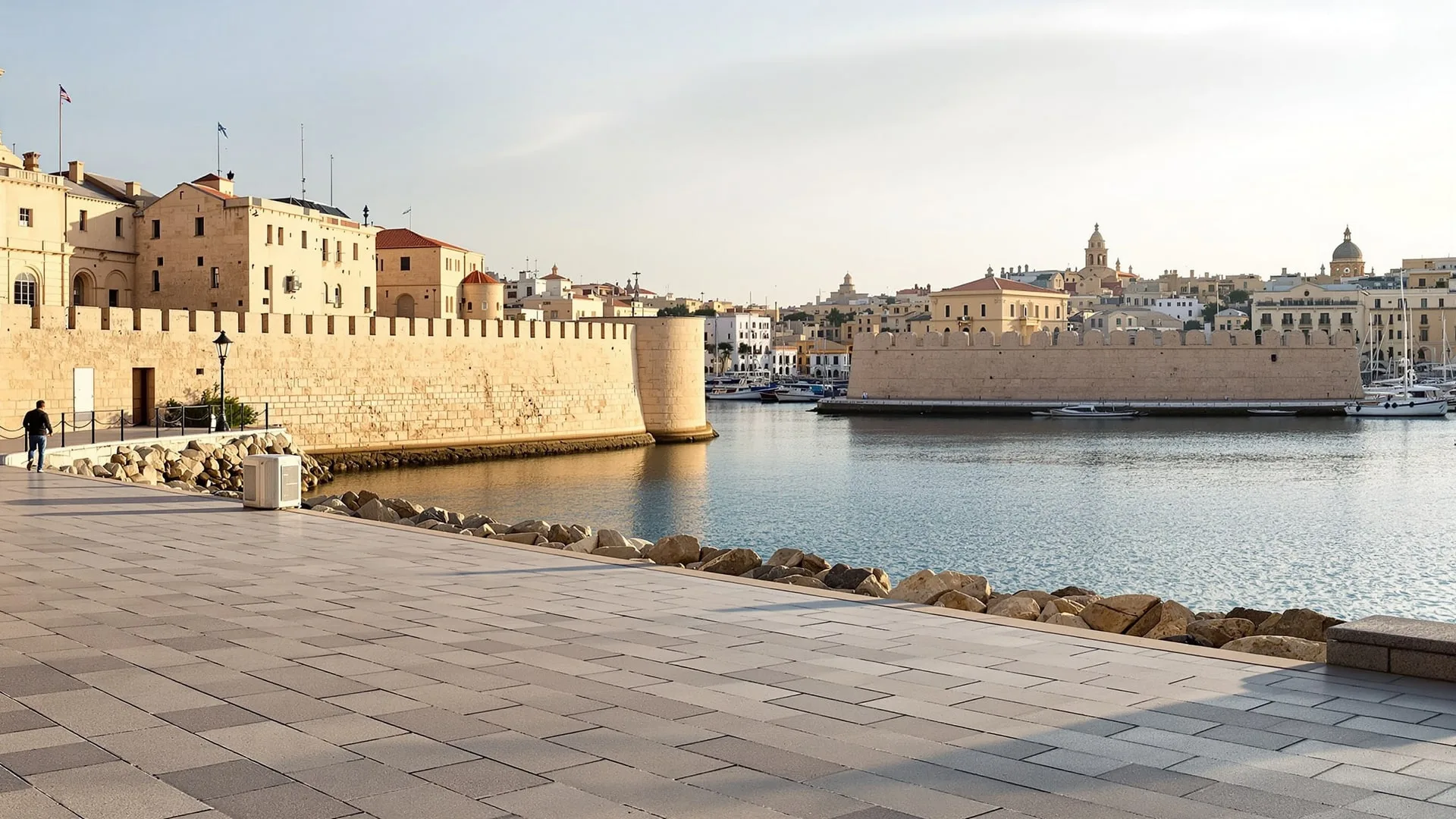
A Saturday in the Three Cities with almost no tourists
A January Saturday in Birgu, Senglea and Cospicua — when the cruise ships are gone and the Three Cities belong to the people who live there
At a glance: a winter Three Cities day
| Where | Birgu (Vittoriosa), Senglea and Cospicua (Bormla), across the Grand Harbour from Valletta |
| Cost | Ferry around €2 one-way; lunch with wine around €20-25; Fort St Angelo entry a separate ticket |
| Time needed | Half a day minimum, a full day if you want to walk the Cottonera Lines too |
| Getting there | Valletta ferry from Lower Barrakka wharf (around 10 minutes), or bus/taxi via the Cospicua approach road |
| Best time | A winter weekday or Saturday out of season; avoid days when cruise ships are docked |
January in the Three Cities
I took the ferry from Valletta on a Saturday in January. Not the tourist season; not any particular festival. The kind of January Saturday when the cafes in Valletta have more staff than customers and the streets around Republic Street are genuinely quiet for the first time since April.
The water ferry from Valletta’s Lower Barrakka wharf to Birgu (officially Vittoriosa) costs a couple of euros and takes about ten minutes. On the way over, you pass under the artillery bastions of the Grand Harbour, the limestone walls of the city rising steep from the water, with Fort St Angelo growing slowly larger on the right side as the boat swings across the channel. In summer, this crossing is done in the company of camera-wielding tourists comparing it to Venice. On this Saturday, there were four of us on the boat, one of whom appeared to be a commuter heading home with shopping.
That was the entire tone of the day. The Three Cities in January belong to the people who live there.
The context: what the Three Cities actually are
Birgu (Vittoriosa), Senglea, and Cospicua (Bormla) are three small peninsulas that project into the Grand Harbour opposite Valletta. They are known collectively as the Three Cities or il-Birgu il-Belt il-Bormla — the names shift depending on whether you are using official designations or local usage. The Knights of Malta fortified all three and used them as their primary base before building Valletta in the 1560s. Birgu was the original seat of the Knights from their arrival in Malta in 1530; Fort St Angelo on its tip was already ancient when they arrived.
During the Second World War, the Three Cities were the most heavily bombed area of an island that was itself among the most bombed places on Earth. The dockyard that the Germans and Italians were trying to destroy was here. The residential areas around it took catastrophic damage — entire streets destroyed, rebuilt in the 1950s in a spare vernacular that has a different quality from the baroque of Valletta. That history makes the Three Cities a more layered place than they initially appear. The restored waterfront of Birgu is one layer; the 1950s reconstruction behind it is another; the surviving baroque churches and the original medieval street pattern are a third.
What brings tourists to the Three Cities, when they come, is the combination of Fort St Angelo, the harbour views from Senglea Point, and the sense of a world slightly removed from the heavily visited Valletta. In summer, particularly when cruise ships are in, the Birgu waterfront can get genuinely crowded. But it is never as crowded as Valletta, and in January, it is almost entirely local.
Birgu without the crowds
Birgu is one of those places that tourism has partially reclaimed but not yet consumed. The main commercial street that runs from the ferry landing to the main gate has restaurants, cafes, and a few shops oriented toward visitors. But two minutes of walking into the alleyways behind — the tight, slightly warped lanes that do not appear on most visitor maps — and the neighbourhood feels like a working Maltese community: washing on the lines between windows painted in that particular Maltese palette of deep green and yellow, a man sweeping a doorstep, two women talking through adjacent windows in Maltese.
The main street along the waterfront marina is where the restaurants and cafes cluster, and most were open on this January Saturday. A few were doing a reasonably steady lunch trade — Maltese families out for a weekend meal, mostly, with a couple of visiting pairs. The famous seafront bars were quiet enough that I could actually sit outside with a coffee and watch the Grand Harbour without elbowing anyone, without waiting for a view to open up in a crowd.
Fort St Angelo was my first stop. In summer, there is a queue. In January, I was effectively alone inside for the first thirty minutes after opening. The audio guide is excellent — the fort has a genuinely dense history that spans the Knights of Malta, two consequential sieges (the Great Siege of 1565 and the earlier one of 1551), the Second World War (Malta’s most famous chapter, the George Cross awarded to the whole island), and the eventual handover to Heritage Malta after years as a Royal Navy facility.
The structure itself is extraordinary: multiple levels built over many centuries, with the oldest sections dating to the early medieval period, and the harbour views from the upper cavalier among the most dramatic perspectives on the Grand Harbour.
Without the pressure of moving through crowded spaces, you can actually stand on the upper level and look at Valletta properly, instead of waiting for a gap in the photograph-taking crowd. In January light — low, clear, slightly golden even at midday — the view is extraordinarily beautiful.
Birgu: Fort St. Angelo E-ticket with Audio Tour↗Senglea: the view that surprises everyone
From Birgu, a short walk or water taxi takes you to Senglea. This is the least visited of the Three Cities, which makes it the most interesting for anyone who actually wants to understand the area. The gardjola garden at Senglea Point — a small promontory with a decorated limestone watchtower, the vedette, carved with an eye and an ear as symbols of vigilance — gives what is quite possibly the best view of Valletta from anywhere in the harbour area.
In high season, that viewpoint gets busy. In January, on a Saturday lunchtime, I sat on a bench and had the entire gardjola to myself for twenty minutes. The view across to Valletta is extraordinary: the full sweep of the city on its promontory, with St John’s Co-Cathedral clearly visible above the bastions, the Upper Barrakka Garden delineated, the Siege Bell Memorial just below it. You understand from this angle that Valletta really is built on a narrow peninsula entirely surrounded by harbours — on this side the Grand Harbour, on the other side the Marsamxett Harbour. The city is a fortress on a finger of land jutting into the sea.
Senglea village itself is small and very residential. There are a couple of cafes, a church — the Basilica of Our Lady of Victories, which has a fine interior — and narrow streets that feel genuinely occupied. On this Saturday, kids were playing football in a small square, using chalk lines on the limestone as boundary markers. An old man was training a pigeon on a rooftop. This is not a performance of local life for visitors; it is local life.
Cospicua: the one everyone forgets
Cospicua (Bormla) is the third of the Three Cities and the largest by population, but the least architecturally dramatic. It forms the hinge point between Birgu and Senglea and has its own waterfront area with a large marina complex that has been developed more recently than the other two.
Most tours include Cospicua only briefly, if at all. Walking through the main streets near the marina on this January Saturday, I understood why: it is the most ordinary of the three, more working town than historic monument. But that ordinariness is also its interest on a quiet day. There is a covered market area that had a small Saturday morning crowd. The fortifications above the town — part of the Cottonera Lines, the outer ring of defensive walls that once enclosed all three cities — are largely overlooked by visitors and are accessible for free.
The Cottonera Lines are, to be honest, one of the more impressive pieces of military engineering in Malta, and that is saying something on an island that spent several centuries being aggressively fortified. The sheer scale of the outer walls, the bastions, and the gate complex reflects the paranoia of the Knights after the Great Siege and their determination never to be nearly overwhelmed again. Walking along the outer walls gives a different perspective on the Three Cities — from outside the fortifications looking in, rather than from the waterfront looking across.
What changes in winter
The main practical difference in January is that some restaurants and cafes have reduced hours or take their annual closure entirely. The touristy establishments along Birgu’s waterfront are mostly open; some of the smaller cafes in Senglea and Cospicua follow more variable winter schedules. Going at midday rather than evening is the safer bet in January; evening closures are more common.
Temperature in January was around 15 degrees, with some wind. The fortress walkways of Fort St Angelo can be cold and exposed in wind, so a proper jacket is necessary rather than optional. The compensation is that the low January light on the Grand Harbour is extraordinary — a silver, horizontal quality that photographers who come in July never see.
The boat ferry from Valletta runs year-round and was reliably punctual throughout this day. The crossing is one of the nicest ways to arrive at the Three Cities regardless of season — the approach from the water gives the full theatrical experience of the fortified harbour.
A meal and a reason to linger
I had lunch at one of the restaurants on Birgu’s waterfront before heading back. A seafood pasta and a glass of local wine cost around 22 euros — significantly less than the equivalent meal on Republic Street in Valletta. The service was relaxed and unhurried, the kind of pace that requires nothing of you and invites lingering.
This is the rhythm of the Three Cities in winter: nothing rushing, nothing particularly trying to extract money from you, a beautiful setting and a genuine sense of existing somewhere with actual daily life happening around it. A couple of locals came in for coffee at the bar. The barman knew them by name.
For planning a visit to the Three Cities, allow at least half a day, ideally arriving by the Valletta ferry and walking between all three. If you want to go deeper on the history, the Three Cities walking tour with a licensed guide covers the Inquisitor’s Palace — which is genuinely remarkable and easy to miss if you are self-guiding — alongside the main sites.
For a wider winter Malta trip, the Three Cities belong near the top of your list. Not despite the quiet, but because of it. This is where you find the version of Malta that the brochures for summer sun holidays are not selling — layered, slightly melancholy, beautiful, and entirely real.
Getting the timing right
If you can only do one Three Cities visit, a winter Saturday morning is close to optimal: the ferry runs a normal schedule, most waterfront restaurants in Birgu are open for lunch, and the cruise crowds that fill the same streets from April onward simply are not there. Weekday mornings out of season are quieter still, though a few of the smaller cafes in Senglea and Cospicua keep shorter or more unpredictable winter hours, so a walk-in rather than a reservation is the practical approach either way. Compare this to a July afternoon, when the same Birgu waterfront can feel closer to Valletta’s Republic Street than to the residential town it actually is.
Anyone weighing whether to combine the Three Cities with Mdina or the Blue Grotto on the same trip should treat them as separate half-days rather than try to force all three into one — the ferry crossing and the walking between Birgu, Senglea and Cospicua already fill a relaxed morning on their own.
FAQ
Is Fort St Angelo worth the entry fee if I’ve already seen Valletta’s Grand Master’s Palace? Yes — the history is different (Knights, Great Siege, WWII Royal Navy base) and the harbour views from the upper cavalier looking back at Valletta are arguably better than anything from inside Valletta itself.
Can you visit the Three Cities without a car? Easily — the Valletta ferry to Birgu is the standard approach, and Birgu, Senglea and Cospicua are close enough to walk between in under an hour combined.
Related guides

The Three Cities walking tour: Birgu, Senglea and Cospicua
The Three Cities walking tour: Birgu, Senglea and Cospicua. Fort St Angelo, Inquisitor's Palace, ferry from Valletta, and the best honest route to follow

Fort St Angelo in Birgu: tickets, history, and the cavalier
Fort St Angelo in Birgu is Malta's most historically significant fortress. Great Siege history, what to see inside, audio tour, tickets, and how to visit

Malta in winter: the case for a serious shoulder destination
Malta in winter is quiet, cheap and genuinely rewarding for culture. 13–17°C, no crowds, 40% lower hotel prices. Sea not swimmable but all sites are open

Valletta and the Three Cities: a day on the Grand Harbour
Spend a day exploring Valletta and the Three Cities (Birgu, Senglea, Cospicua) by ferry across the Grand Harbour. Walking route, ferry prices, honest timings