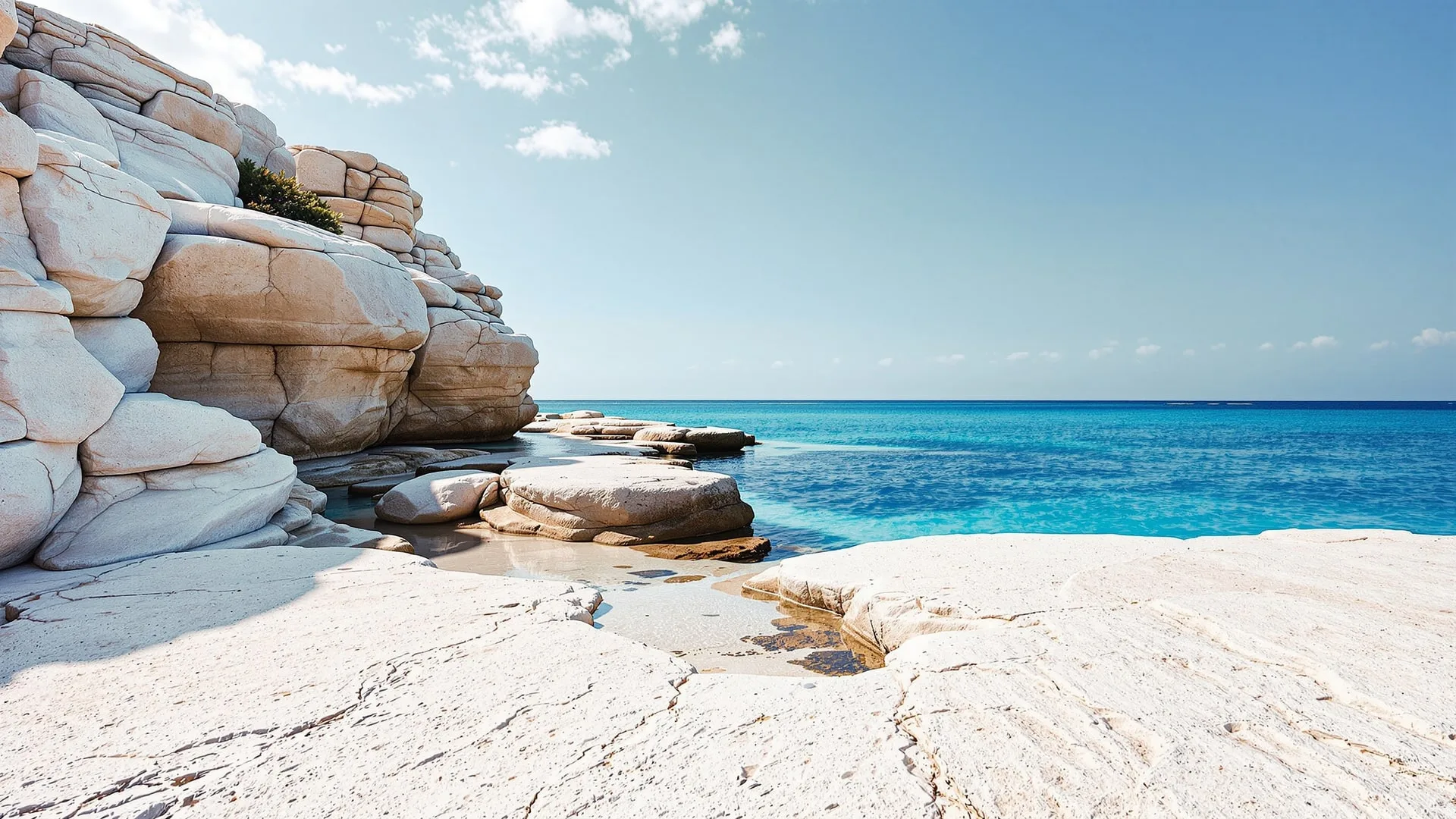
Malta's beaches are mostly rocks. Here's why I love them anyway
Malta is 80% rocky coastline. After years of visiting, I've come to prefer it — here's the honest case for Malta's limestone swimming holes
At a glance — rocky vs sandy in Malta
| Coastline that’s rocky limestone | Around 80% |
| Main sandy beaches | Mellieha Bay, Golden Bay, Ghajn Tuffieha, Ramla Bay (Gozo) |
| Essential kit for rocky shores | Water shoes, around €8-15 locally |
| Best month for rocky swimming | September (sea peaks 25-26°C, crowds thinning) |
| Typical lido entry fee | Around €3-8, usually includes a sun lounger |
The thing travel photos never show you
If you have done any research on Malta, you have seen the photographs: crystalline turquoise water lapping at limestone cliffs, swimmers floating in improbable blues, the dramatic rocky coves around Gozo’s western coast. Beautiful. Accurate. And also slightly misleading about what most beach experiences in Malta actually involve.
What those photographs carefully crop out is the process of getting into the water. Which usually involves walking along a concrete path, descending a metal ladder fixed into the rock, lowering yourself carefully into the sea from a stone shelf, and then floating away from the sharp limestone to deeper water. That is, for most of Malta’s coastline, the swimming experience.
This is not a complaint. After four visits to Malta — each one longer than the last — I have come to genuinely prefer it. But I want to be honest about what you are getting before you arrive expecting the sand-and-shoeless-shuffle experience of a beach holiday in Spain or Greece.
The geology determines everything
Malta is a limestone island, and limestone erodes into sharp, jagged forms rather than the smooth, crumbling particles that make sand beaches. Where there is sand — Mellieha Bay, Golden Bay, Ramla Bay in Gozo — it was deposited by specific geological or marine conditions that do not apply to most of the coastline. The island’s shape itself, the plateaus dropping sharply to the sea, means that most coastal access is a vertical relationship with the water rather than a gradual one.
The rest is karst limestone: carved by water into dramatic platforms, sea caves, arches, and natural pools, but offering no soft landing for bare feet. Rubber-soled water shoes are not a luxury item in Malta; they are essentially required equipment for most rocky coastal swimming. The limestone around water entry points is often sharp enough to cut and almost always textured enough to be painful on unprotected soles. Sea urchins inhabit the crevices at most entry points.
This is the foundation of the most common honest complaint about Malta’s beaches: people arrive expecting a standard Mediterranean sandy-beach experience and find instead that the island’s swimming culture is built around lidos, ladders, and limestone platforms.
Why the limestone shores are actually special
Here is what the sandy-beach expectation misses: Malta’s rocky coastline produces some of the clearest, most beautiful swimming water in the Mediterranean.
The absence of sand means the water around most rocky Maltese shores is not silted or clouded. It is deep and clear right from the edge, in the way that sandy beaches often are not. The famous blue of the water around Malta and Gozo — that specific, almost theatrical electric blue — is partly a function of the limestone geology filtering and reflecting light through clear water. You do not get this effect in sandy-beach conditions.
St Peter’s Pool is the example I come back to. A natural rock pool carved by the sea into the limestone south coast near Marsaxlokk, it has no sand, no sun loungers, no facilities. What it has is extraordinary water visibility — you can see ten to twelve metres down to the rock formations below, clearly and without distortion. Jumping from the overhanging limestone slabs into that water, floating in a colour that is genuinely that shade of turquoise, is an experience that no sandy beach quite replicates.
Several tour boats visit St Peter’s Pool specifically as a swimming stop:
From Marsaxlokk: St Peter's Pool Boat Tour↗The Blue Grotto is another example. You access it by boat, passing through sea caves where the water takes on completely different hues as light refracts through the cave openings. The colours shift from aquamarine to cobalt to something almost violet in the deepest sections. There is no sand involved at any point. The experience is entirely defined by the limestone architecture and the water quality — and it is magnificent.
Divers understand this instinctively. Malta is one of the best diving destinations in the Mediterranean precisely because the rocky coastline produces the conditions that diving requires: clear water, interesting underwater topography, walls, caves, and wrecks. The Um El Faroud wreck dive at the south of Malta, the cave diving at Dwejra Gozo, the Blue Hole — these are world-class dive sites that exist because of the rocky limestone geology, not despite it.
If you are a diver or want to try diving: Discovery dives and certified boat dives are readily bookable from most resort areas, and the visibility and variety are exceptional compared to most European dive destinations.
Malta: Boat Dive Trip for Certified Divers↗The swimming infrastructure: lidos explained
Malta has developed a specific cultural response to managing the rocky coastline: the lido. Lidos are privately managed rocky waterfront areas — usually a concrete or stone platform with changing facilities, showers, a bar or café, sun loungers, and managed steps or ladders into the sea. They charge a modest entry fee (typically 3-8 euros) that includes a sun lounger on the platform.
For regular swimmers, a quality lido is often preferable to a sandy beach: the water is clean and tested, the platform gives you a defined space with shade options, the facilities are available and maintained, and the managed entry points make getting in and out of the water easier than scrambling over open limestone. Many of the most serious Maltese swimmers are lido regulars rather than beach-goers.
The lidos vary considerably in quality and setting. The best have genuinely beautiful platform positions — above sheltered coves, on promontories with long sea views — and the facilities are well-maintained. A good lido in September is a very pleasant way to spend a morning.
If you genuinely want sandy beaches
If sand is non-negotiable for you, the options are:
Mellieha Bay (Ghadira Bay): The largest sandy beach in Malta. Proper sand extending into shallow water, with lifeguard services, beach bars, and watersport rentals. Gets very busy in summer — a July or August weekend here is genuinely crowded. Arrive before 8:30am or after 4pm.
Golden Bay: Beautiful setting, red clay cliffs framing a sandy cove. Smaller than Mellieha but more scenic. Facilities available in season. Worth it in shoulder season; overcrowded in peak August.
Ghajn Tuffieha (Riviera Beach): Adjacent to Golden Bay but requires a steep 200-step descent. The effort keeps it quieter. No facilities apart from a seasonal kiosk. Sandy and lovely.
Ramla Bay (Gozo): The best beach in the archipelago by most measures. Wide, distinctively orange-red sand (the iron-rich clay from surrounding cliffs), protected by national park status. No commercial beachfront development. Quieter than Mellieha even in peak summer, though it does get busy. Accessible by bus or tour from Victoria.
Outside of those four, manage your expectations. Everything else is rocky and, if you engage with it properly, genuinely wonderful.
What the water shoes situation actually looks like
I have watched many experienced Mediterranean travellers arrive at a Malta rocky shore in flip flops and immediately understand the problem. Flip flops are not adequate. The limestone edges around entry points are not smooth. They have sharp edges, irregular surfaces, and often sea urchins in the crevices. Walking along exposed limestone platforms in flip flops is uncomfortable; walking over entry ledges is genuinely risky.
Water shoes: neoprene or similar, rubber-soled, close-toed. Buy them before you arrive (they are cheaper in most countries) or find them at any tourist shop, sports store, or pharmacy in Malta. They typically cost 8-15 euros, and they completely transform the rocky-shore experience.
With water shoes on, the access issue largely dissolves. You walk to your entry point, descend the ladder or walk to the deepest ledge, hold the shoes while you swim, then put them back on to get out. That thirty-second process is all that stands between you and access to some extraordinarily beautiful swimming.
Rocky swimming spots worth seeking out beyond the big names
Beyond St Peter’s Pool and the Blue Grotto, a handful of quieter limestone spots reward the trip. Dwejra on Gozo, best known for the collapsed Azure Window, has excellent rocky swimming at the Inland Sea channel itself, alongside the more serious Blue Hole dive site. The coastline near Xlendi on Gozo offers sheltered rocky coves with managed steps, quieter than the archipelago’s headline spots but just as visually striking. Around St Julian’s, the rocky shore below Exiles and Balluta Bay gets you swimmable, clean water within walking distance of hotels, without needing a boat or a car.
What lidos actually cost and include
The lido system is worth understanding before you arrive, since it’s unfamiliar to visitors used to open, free beach access. A typical lido charges an entry fee of around €3-8 per person on weekdays, sometimes more at premium locations or weekends, and that fee usually includes use of a sun lounger and umbrella, changing rooms, and showers. Food and drink at the lido’s bar or café is charged separately and priced similarly to a normal seafront café. Towel rental is sometimes available for a small extra charge; bringing your own is cheaper and simpler.
The reframing that made Malta’s coast click for me
The shift in my own thinking came after a swim at Wied il-Mielaħ (the Window of the Winds) on Gozo’s west coast. It is accessible only by a long walk across rough terrain, there is no facility of any kind, and the entry requires lowering yourself through a narrow gap in the rock into a churning sea channel with kelp below you and limestone walls on both sides.
It was, on the day I went, the most beautiful and most memorable swimming experience of my life.
Malta’s rocky coastline is not a compromise or a consolation prize for the absence of sand. It is a different kind of coastal experience — harder to access, more dramatic, fundamentally wilder, and ultimately more memorable. The island’s geology produces something genuinely rare: coastline where the architecture of the cliff, cave, and rock formation and the quality of the water combine into something extraordinary. The difficulty of access is partly what creates the beauty — it limits the number of people, it requires intention, and it rewards commitment.
You need the water shoes. You need a slightly different frame of mind than a sandy-beach holiday requires. And you need to give it a chance before deciding it is not for you. On my first Malta visit, I was disappointed by the beaches. By the fourth visit, I was coming specifically for the limestone swimming holes.
Practical advice for rocky shore swimming in Malta
Essential equipment: Water shoes (non-negotiable), a rash vest or wetsuit if you plan extended swimming in April-May (water is 17-19°C), a dry bag for your phone and keys, sun protection.
Best rocky spots for first-timers: St Peter’s Pool near Marsaxlokk is probably the most accessible dramatic spot. Marsaskala has some good entry points near the town. Sliema’s rocky waterfront has multiple managed entry points close to accommodation.
Best for experienced swimmers: Wied il-Mielaħ (Gozo), Blue Hole (Gozo), the natural pools at the base of the Dingli Cliffs, St Peter’s Pool at dawn.
When to go: September is the sweet spot for rocky swimming — sea temperature peaks at 25-26°C, crowd numbers are falling from August peak, and the quality of light for the experience is extraordinary.
For planning a beach-focused visit to Malta that balances sandy and rocky options across your trip, see our full guide. And for Gozo coastal swimming specifically, the west coast from Dwejra to Xlendi offers the most dramatic rocky swimming on the archipelago — genuinely world-class and still relatively unknown outside the diving community.
FAQ
Do I really need water shoes in Malta? Yes, for almost all rocky shore swimming — the limestone entry points are sharp and often hide sea urchins in the crevices; they cost around €8-15 locally and make a real difference.
Are there any proper sandy beaches in Malta? Yes — Mellieha Bay, Golden Bay, Ghajn Tuffieha and Ramla Bay in Gozo are the main sandy options, though all get busy in peak summer.
Related guides

Best beaches in Malta, Gozo and Comino: sandy vs rocky — the honest guide
80% of Malta's coast is rocky. This guide names every real sandy beach, the best rocky swim spots, and which Instagram beaches are overcrowded traps.

Blue Lagoon overcrowding: the honest truth about Malta's most hyped spot
3,000+ visitors, diesel water, €8 hot dogs. Blue Lagoon at noon in July is not the photos. Go before 9:30am or after 17:00. Honest alternatives inside.

Blue Lagoon without the crowds: when to actually go
How to visit the Blue Lagoon in Comino without the July-August crowds: before 9:30am, after 5pm, shoulder season, and the quieter alternatives nearby

Malta cruise stop: what you can actually do in 6 hours vs what's sold to you
You have 6 hours in Valletta on a cruise stop. Blue Lagoon and Gozo are not realistic. 3 honest itineraries for what you can actually see — and what to skip.