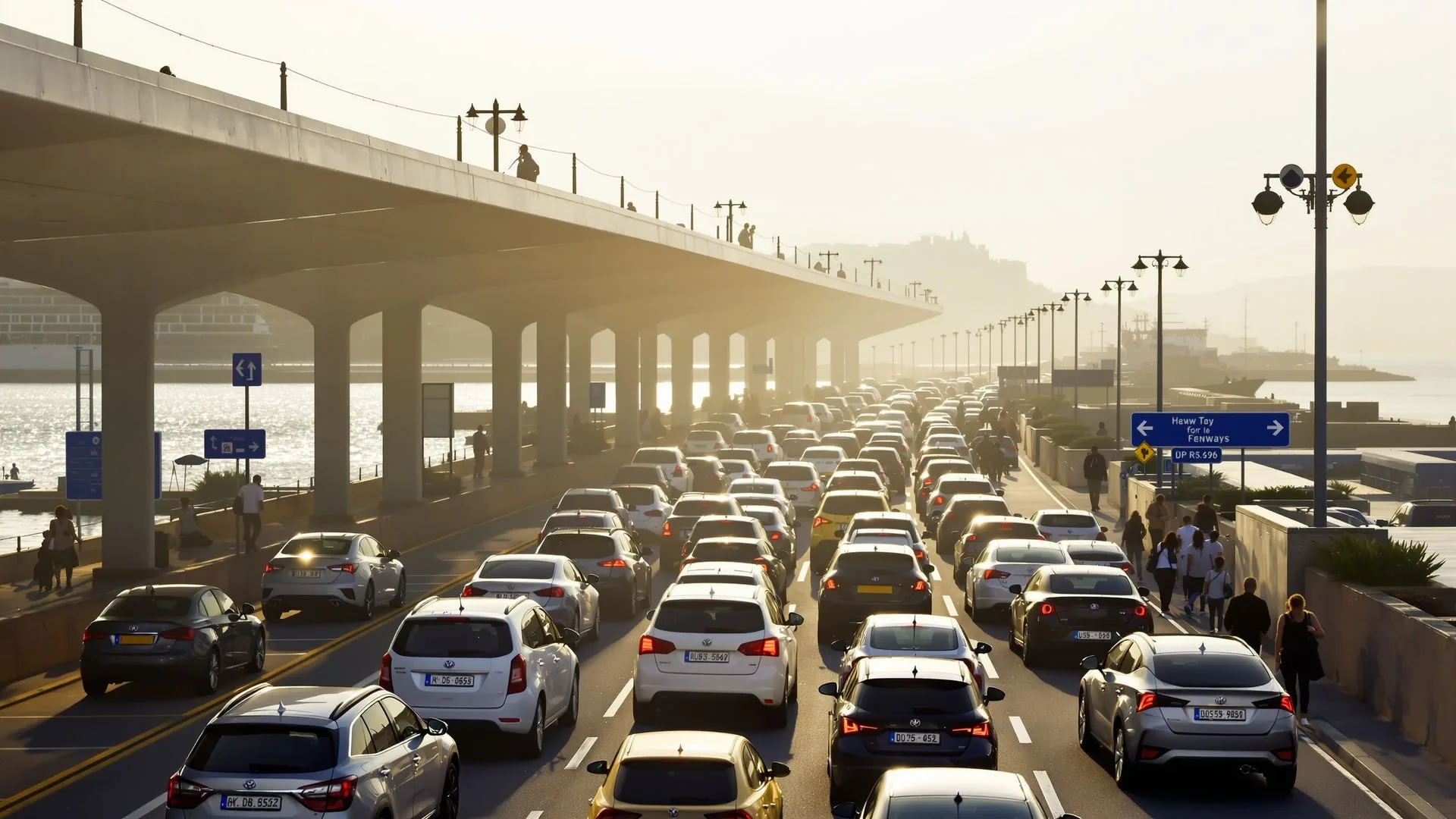
Cirkewwa to Gozo: the queue that ate my summer afternoon
The Cirkewwa–Gozo ferry queues hit record lengths in summer 2023. Here's what happened, how long it took, and how to avoid the same mistake
At a glance: Cirkewwa-Gozo ferry
| Where | Cirkewwa terminal to Mgarr, Gozo |
| Cost (foot passenger) | Around €4.65 return, paid on the Mgarr side |
| Cost (vehicle) | Varies by car size, paid at Cirkewwa |
| Crossing time | About 25 minutes |
| Worst times | Friday afternoons and Sunday evenings in July-August |
| Best times | Weekday mornings before 7:30am, or after 9pm |
The afternoon I lost to a car queue in a car park
It was a Thursday in late July. We had a full day plan: morning in Gozo, lunch in Marsalforn by the water, an afternoon drive out to Dwejra to watch the sun drop over the cliffs, and a comfortable return to Malta in time for dinner in Sliema. We had been to Gozo three times before and always managed the ferry without drama. We arrived at Cirkewwa ferry terminal at 4:15pm feeling very organised.
The sign at the terminal entrance said the next vehicle ferry was departing at 5pm. The car park queues stretched back past the petrol station and onto the main road. We sat in that queue until 6:40pm and caught the 7pm sailing.
That was two hours and twenty-five minutes of stationary car, in 32-degree heat, watching the departure board flip the 5pm sailing, then the 5:45pm sailing, then the 6:30pm sailing off the screen while the queue barely moved. Dinner in Sliema became a petrol station snack on the way home. The Dwejra sunset happened without us.
This is the Gozo ferry queue in summer 2023, and if you are planning a trip to Gozo between June and September, you need to understand this before you book anything.
Why the queue got so bad in 2023
The Cirkewwa to Mgarr ferry is operated by Gozo Channel, a state-owned company. The crossing takes 25 minutes and ferries run all day and most of the night, with intervals of 45 minutes to an hour in peak season. In theory, that should be adequate. In practice, summer 2023 pushed demand to levels that exposed persistent structural problems with the system.
The ferry fleet has a fixed capacity, and vehicle demand — particularly from Maltese residents visiting Gozo for summer weekends and from tourists who have rented cars — has grown faster than the fleet has expanded. The Cirkewwa terminal has a limited queuing area, so when it fills, vehicles spill onto the main road. There is no reservation system for vehicles: it is strictly first come, first served. There has been a functioning online booking system discussed for years; as of 2023, it remained theoretical.
The result, in peak summer, is that the afternoon ferry from Malta to Gozo and the evening ferry from Gozo back to Malta both become serious bottlenecks. The Gozo-to-Malta direction on Sunday evenings is particularly brutal, with queues that regularly exceed three hours. Stories of Gozo residents missing work on Monday morning because they were still in the queue at midnight on Sunday have circulated for years in the Maltese press.
The summer of 2023 was particularly bad, partly because of a record tourism year, partly because one of the ferry vessels was out for maintenance for part of the peak season, and partly because the pent-up demand from the COVID years had not fully dissipated. The combination produced the kind of delays that generated significant media coverage in Malta and prompted renewed political debate about long-term infrastructure solutions.
The foot passenger experience is completely different
Here is the thing nobody tells you clearly enough: if you travel as a foot passenger, there is no queue. At all.
Foot passengers board the Gozo Channel ferry on the same schedule as vehicles, but they walk straight to the passenger deck without waiting in the vehicle queue. Even in peak summer with a 90-minute vehicle wait, foot passengers are on the boat within minutes of arriving at the terminal.
The passenger fare is 4.65 euros return — one of the best-value ferry crossings in the Mediterranean. You pay at Mgarr on the way back, not at Cirkewwa. Children under 3 are free. The ferry accepts bicycles, which is worth knowing if you are planning to cycle Gozo. Electric bikes are increasingly available to rent on the Gozo side.
If you are going to Gozo primarily to visit Ggantija temples, Victoria, Dwejra, or the main villages, you absolutely do not need a car. The Gozo HOHO bus covers the main sites. Taxis and Bolt operate on the island. Many tour operators run full-day Gozo trips from Malta that include the ferry crossing, transport on Gozo, and often guided visits to the main sites.
Gozo Full Day visiting Ggantija Temples, Salt Pans & Dwejra↗When vehicle queues are worst
Based on 2023 experience and general patterns, here is when you should avoid the vehicle ferry:
Worst times on the Malta-to-Gozo direction:
- Friday afternoons from 2pm to 8pm (Maltese residents heading to Gozo for the weekend; this is the pattern that has existed for decades)
- Saturday mornings from 8am to 11am (the day-tripper wave)
- Any afternoon during public holidays, which Malta has a significant number of
- The first two weeks of August, when Maltese summer holidays peak
Worst times on the Gozo-to-Malta direction:
- Sunday afternoons from 2pm to 9pm (absolute worst; consistent 2-3 hour queues in summer 2023, occasionally longer)
- Monday mornings during summer (late-returning weekenders)
- Any evening after a major Gozitan festa when half the island has been at the fireworks
Best times to travel by vehicle:
- Weekday mornings before 7:30am
- Midday on weekdays (11am to 1pm)
- Late evening after 9pm when queues drop sharply
- Off-peak months: April, May, October, November (shoulder season queues are minimal)
The physics of the problem
It is worth understanding why the vehicle queues are specifically so much worse than the passenger queues. Each ferry crossing holds approximately 800-900 passengers but only around 80-100 vehicles. The ratio means that vehicles fill the ferries much more quickly than passenger demand alone would require.
In busy summer periods, the vehicle capacity is effectively always at capacity from mid-morning to late evening. Foot passengers, by contrast, rarely fill the passenger decks — there is almost always space. This asymmetry is why foot passenger travel is so dramatically more efficient.
It is also worth understanding the geographic reality. Cirkewwa is at the northern tip of Malta, requiring either a car trip up the length of the island from Sliema (about 45 minutes) or a combination of buses. The Gozo ferry is not something you spontaneously jump on from the city. Planning and timing are always part of the experience.
Alternatives to the vehicle Cirkewwa ferry
If you want to visit Gozo and the vehicle ferry situation is putting you off, several alternatives are worth serious consideration.
The fastest and most comfortable option for many visitors is an organised guided day trip from Valletta, Sliema, or Bugibba. These handle the ferry crossing, include transport on Gozo, and often cover entry to the key sites. You spend a long day but avoid any logistical headache.
From Malta: Gozo Day Trip Including Ggantija Temples↗The high-speed catamaran from Valletta to Gozo bypasses the Cirkewwa road queue entirely. It departs from the Valletta waterfront and arrives at Mgarr harbour in about 45-50 minutes. You then use taxis or the Gozo HOHO bus for the island. This is particularly useful for people who want to explore Gozo independently without driving.
If you genuinely need a vehicle on Gozo — to explore the western coast, reach remote bays like Mgarr ix-Xini, or stay for multiple days — the least painful approach is to cross very early (before 7am) or very late (after 9pm) on a weekday, completely avoiding the Friday-to-Sunday peak period.
Staying overnight on Gozo: the real solution
For a serious visit to Gozo, the single most effective answer to the ferry queue problem is to stay overnight. One or two nights on the island means you cross on a quiet weekday morning, have full days on the island, and return at an hour of your choosing — early morning or late evening, when queues are minimal.
Accommodation on Gozo is generally cheaper than equivalent quality on the main island. The villages of Xlendi, Marsalforn, and Victoria have a good range of hotels, converted farmhouses (locally called farmhouses), and B&Bs. A farmhouse stay in a Gozitan village — often with a private pool and traditional stone architecture — is one of the most distinctive accommodation experiences in the Mediterranean.
For a 7-day Malta itinerary with two nights on Gozo, the logistics work out naturally: drive to Cirkewwa on a Wednesday morning (minimal queue), explore Gozo for two full days without time pressure, and return on a Friday morning before the weekend queue begins.
What actually changed after summer 2023
The summer 2023 queues prompted loud calls for a permanent transport link between Malta and Gozo — a bridge or tunnel that has been debated in Maltese politics for decades, resisted by many Gozitans who value the island’s separateness. As of 2024, no construction decision had been made, but a government feasibility study was ongoing.
Gozo Channel announced plans to accelerate introduction of additional ferry capacity, with a new vessel expected before the 2024 season. Whether this meaningfully reduces peak queues depends on whether the vessel adds sufficient vehicle capacity during the worst hours.
For visitors, the practical advice stays the same regardless of what infrastructure improvements are implemented: travel as a foot passenger where possible, use organised tours or the catamaran if you want a fully managed experience, and if you take a vehicle, cross early or late and never on a Friday afternoon or Sunday evening in July or August.
The honest calculus for your trip
The Gozo ferry situation is Malta’s most persistent practical problem for tourists and is regularly cited in visitor surveys as a significant frustration. But it is also perfectly manageable once you understand it. Knowing that foot passengers have no queue, that the catamaran from Valletta is a real alternative, and that weekday timings make vehicle crossing straightforward — that knowledge turns a potential nightmare into a minor logistical consideration.
For a first trip to Malta of five to seven days, I would always recommend at least one night on Gozo. The island is genuinely worth its own base, not just a rushed day trip. The slower pace, the different character, and the extraordinary western coastline at Dwejra deserve more than a few hours.
For a day trip to Gozo specifically, go as a foot passenger, rent a tuk-tuk or take the HOHO bus on the island, and enjoy your day without any car anxiety. That is almost always the right call in summer — and it is significantly cheaper than bringing a car across.
If you’d rather have the logistics handled entirely, the catamaran-based full-day options bundle the crossing, transport, and site visits in one booking, which removes the ferry-queue question completely.
Malta: Highspeed Catamaran Crossing between Valletta & Gozo↗FAQ
Do foot passengers really skip the entire vehicle queue at Cirkewwa? Yes. Foot passengers board on the same sailings as vehicles but walk straight to the passenger deck, so even a 90-minute vehicle wait doesn’t affect them.
Is there any way to reserve a spot on the vehicle ferry in advance? No, as of the most recent seasons the Cirkewwa-Mgarr vehicle ferry remains strictly first come, first served with no reservation system, which is why timing your crossing outside peak windows matters so much.
Related guides

Ferry from Malta to Gozo: Cirkewwa, Mġarr, tickets and timetable
The Gozo ferry runs from Cirkewwa to Mġarr every 30–45 min in summer. €4.65 return for foot passengers. You pay on the return at Mġarr — not at Cirkewwa

Blue Lagoon overcrowding: the honest truth about Malta's most hyped spot
3,000+ visitors, diesel water, €8 hot dogs. Blue Lagoon at noon in July is not the photos. Go before 9:30am or after 17:00. Honest alternatives inside.

Driving in Malta: left-hand traffic, parking and car rental tips
Malta drives on the left (UK style). Roads are narrow and poorly signposted. A car is essential for Gozo. For Valletta and Sliema, skip it. Full guide for 2026

Ferry to Comino: how to get to the Blue Lagoon in 2026
Comino ferries run June–September from Mellieha Bay and Marfa. Return tickets cost €10–15. No public ferry in winter. Full guide to timings and operators